
The property tax on a Texas listing probably isn't your tax bill

One number breaks a lot of Texas rental deals: the property tax on the listing.
It looks official. It's printed right there next to the HOA dues and the square footage. So it goes straight into the spreadsheet, the rent covers it with room to spare, and the deal looks great. Then the first full tax bill shows up in the new owner's name, and it's nearly double what anyone expected.
The tax figure on a Texas listing is usually the seller's bill, built on the seller's exemptions, the seller's caps and the seller's history with the appraisal district. Most of that doesn't come with the house. If you're buying a rental, figure your own bill from the market value and the full tax rate, with no exemptions, before you make an offer.
Below: why that number is so often wrong, how to rebuild it yourself in about twenty minutes, and the four questions we'd ask before trusting any tax figure in a deal.
Why the seller's tax bill doesn't transfer to you
Texas has no state property tax. Your bill comes from local taxing units, like the county, the city, the school district, and sometimes a hospital district, a community college or a utility district. Each one sets its own rate. The appraisal district in each county puts a value on the property, and every unit taxes that value at its own rate, minus whatever exemptions the owner qualifies for.
Look at that last part again: the owner. Exemptions and limits follow the person, not the property. A seller who has lived in a house for fifteen years may be carrying three advantages a rental buyer won't get.
The homestead exemption. When the house is someone's main home, a chunk of its value is exempt from school taxes, and many cities and counties offer their own homestead exemptions on top. The school-district piece is now $140,000, up from $100,000, after the Legislature passed Senate Bill 4 in 2025 and voters approved the constitutional amendment that November. A rental isn't anyone's homestead, so none of that applies to you.
The 10% homestead cap. On a homestead, the appraisal district can't raise the appraised value more than 10% a year (plus new improvements), even if the market jumps 30%. Over a decade, the gap between what a house is worth and what it's taxed on can get wide. But under Tax Code Section 23.23, the cap ends on January 1 of the first tax year that the owner, or the owner's spouse or surviving spouse, no longer qualifies for the homestead exemption. When you buy it, the house goes back to being taxed on its full market value.
The senior school-tax ceiling. If the seller is 65 or older or disabled, their school taxes on that homestead may be frozen at a ceiling. That ceiling ends on the first January 1 after the qualifying owners no longer live there as their homestead. It doesn't pass to a buyer.
Put those together on a house where an older couple has lived for years and the listed tax can come in at half of what an investor will actually owe.

A made-up example, so you can see the gap
This one is hypothetical, with round numbers to make the point. It's not a real deal of ours or anyone else's.
Say a three-bedroom house in a Texas suburb is listed for $300,000. The listing shows annual taxes of about $3,000. The sellers are a retired couple who've lived there a long time. Because of the 10% cap, the appraisal district taxes it on $220,000 even though its market value is $300,000. They get the school-district homestead exemption, the extra senior exemption, and a frozen school tax on top of that.
Now say the combined rate for every taxing unit at that address is 2.2%. That's a made-up rate for this example; yours could be higher or lower, so look it up. As a rental with no exemptions and no cap, the math is $300,000 × 2.2%, or about $6,600 a year.
That's roughly $3,600 a year, or $300 a month, that the listing never showed you. On a rental that was supposed to clear a couple hundred dollars a month, $300 decides whether you make money or lose it.
The listing wasn't wrong. It was the sellers' bill, not yours.
Two more things that catch investors off guard right now
The year you close isn't the year that hurts. Texas generally decides exemptions based on who owns the property on January 1. So if you buy in the spring, the bill for that year is usually still figured with the seller's homestead in place, and taxes are prorated between you and the seller at closing. Closing usually prorates on an estimate, so ask your title company how they'll handle it if the final bill comes in different. The full, no-exemption bill arrives the next year. That's when the escrow account comes up short and your monthly payment jumps. Plan for the second year, not the first.
The 20% cap for other property is scheduled to end. In 2023, Texas added a "circuit breaker" in Tax Code Section 23.231. It limits appraisal increases to 20% a year on non-homestead real property under a value threshold, which started at $5 million and is adjusted for inflation each year. Two details matter for a buyer. First, it doesn't start for a new owner until January 1 of the year after the first January 1 they own the property, and the seller's limit ends when they sell. Second, the statute says the section expires December 31, 2026. Put those together and even a rental you buy this year won't benefit, because your cap wouldn't start until after the law is set to expire. The Legislature meets again in January 2027, so if a deal you're looking at counts on that cap holding values down, check where it stands before you rely on it.
If the land has an agricultural or open-space valuation and you plan to change how it's used, ask about rollback taxes too. That's its own topic, and it's worth an hour with your title company or a property tax professional before you sign.
How to estimate the tax on a Texas rental before you offer
You don't need special software. You need the appraisal district's website and about twenty minutes.
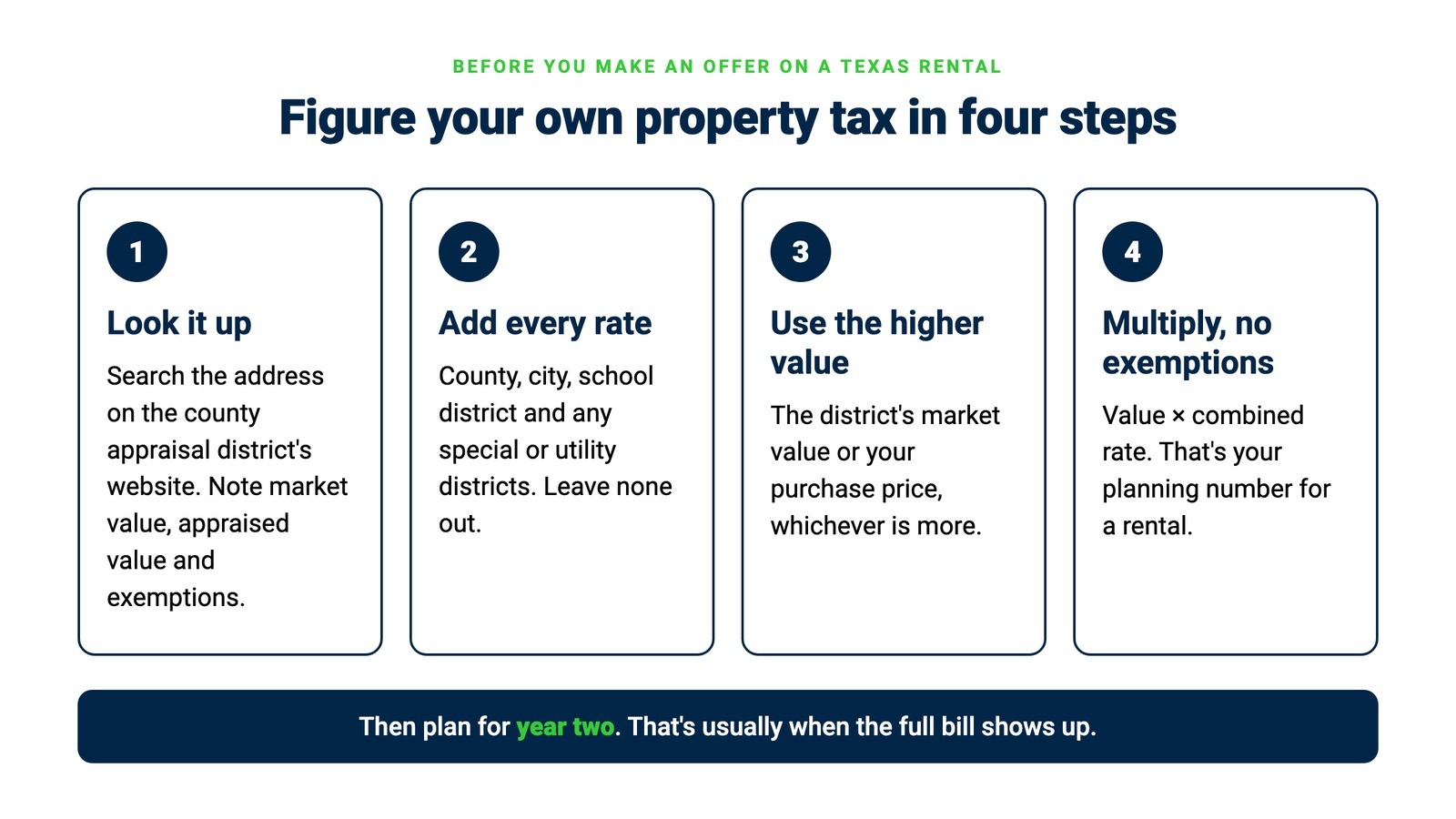
- Pull up the property on the county appraisal district's site. Search by address. Write down the market value, the appraised value and any exemptions listed. If the appraised value is well below the market value, there's a cap in play, and it's going away when you buy.
- Find every taxing unit and its rate. Each appraisal district has to keep a public property tax database, searchable by address, that lists every taxing unit for the property, with links to each one's rate information. Confirm the adopted rates with the county tax assessor-collector, then add them up for every unit at that address. Don't skip the smaller ones. Utility and special districts can add a lot in newer subdivisions.
- Pick the higher value. As a cautious planning number, use the market value on the appraisal district's site or your purchase price, whichever is higher. A renovation, a hot street or a few years of rising sales can push the district's next number up.
- Do the math with no exemptions. Value times the combined rate. That's your planning number. If it breaks the deal, it's better to find out now than in your second year of ownership.
- Write down the protest deadline. If you think the district's value is too high once you own it, Texas lets you protest. The deadline is May 15 or 30 days after your appraisal notice is delivered, whichever is later. A protest might lower the value. It might not. Don't count on it in the numbers.
The four questions we'd ask before trusting any tax number
Vin has more than 21 years in real estate, and since coming to Texas his work has grown into buy-and-hold rentals along with lending and private capital. Holding rentals teaches you that the costs nobody controls, like taxes and insurance, decide whether a rental works. You can set rent and manage repairs, but the tax bill is what it is.
So before a tax figure goes into our numbers, we want answers to four questions.
- Whose bill is this? If it came from a listing, a seller or a wholesaler's sheet, it's someone else's number until we rebuild it.
- What exemptions are on it? Homestead, senior, disabled veteran or anything else on the appraisal record. Each one disappears when the owner changes.
- Is there a cap hiding the real value? Compare the market value to the appraised value. A big gap means a big jump is coming.
- What happens in year two? That's when the real bill arrives and the escrow catches up.
When a deal only works on the seller's tax bill, it doesn't work. Better to pass, or renegotiate the price with the real number in hand. It's hard to argue with math anyone can check on the county's website.
This matters to us for a simple reason. When a rental runs short every month, the owner feels it, and so does everyone connected to the deal: the lender waiting on payments, the partner who trusted the numbers, the family renting the house who needs repairs done on time. Getting the tax right early protects all of them.
If you're working through the rest of your diligence, we also wrote about what to read in a Texas title commitment before you close.

What you get out of doing this yourself
Twenty minutes on the appraisal district's website buys you three things.
First, an offer built on your real cost, so the price you pay is one you can live with. Second, something concrete to negotiate with. "The listing shows $3,000 but our tax as a rental is $6,600" is a better conversation than "can you come down a little?" Third, credibility with everyone you bring into a deal. Lenders, partners and the more experienced people in your network notice when your numbers already account for what most people miss.
It also makes you a useful person to compare notes with in a room full of investors.
A good property tax consultant or CPA can take this further, especially on larger or commercial property, and an attorney is the right call on anything involving ag valuations or unusual exemptions. But the first pass is something anyone can do with a county website and a calculator.

If you're buying rentals anywhere in Texas and want to compare notes with people who check the numbers the same way, come find us at a Michelle & Vin meetup. Bring a deal you're looking at. Somebody in the room will have run into a tax surprise like this one, and we'd rather you hear about it there than from your escrow statement.
Disclaimer: This content is provided for educational, informational, and entertainment purposes only. It is not legal, tax, accounting, investment, financial, or professional advice. Michelle and Vin are not acting as your attorney, CPA, financial advisor, or other licensed professional. Every situation is different. Conduct your own due diligence and consult your qualified professional team before making any business, real-estate, lending, investment, legal, tax, or financial decision. Nothing in this article is a promise or guarantee of results.