
What to read in a Texas title commitment before you close

About two weeks into a purchase, an email shows up from the title company. There's a long PDF attached, with a name that sounds like a formality: Commitment for Title Insurance.
Most people forward it to their agent, file it, and go back to worrying about the inspection. It reads like fine print.
Read it in this order: Schedule C, then B, then A. The title commitment shows you, before you close, the exceptions the title company plans to write into your policy and what still has to be fixed. Ask your questions early, and if something needs to be objected to, make sure a written objection reaches the seller before your deadline.
We'll take the schedules one at a time in plain English, then the deadline a lot of buyers don't know is running.
What a title commitment is, and what it isn't
In Texas, the commitment is a standard form set by the Texas Department of Insurance. It's called Form T-7, and every title company in the state uses the same layout.
The form describes itself plainly. It's the title company's promise to issue a policy, as long as certain requirements are met. It also says what it is not: an opinion or a report on your title.
So read it as a list: what they'll insure, what they're leaving out, and what has to happen first.
The same form tells you, on its first page, to review it carefully before your closing date. And it suggests talking with an attorney about anything in Schedules B and C, because those items affect your title and how you can use the land.
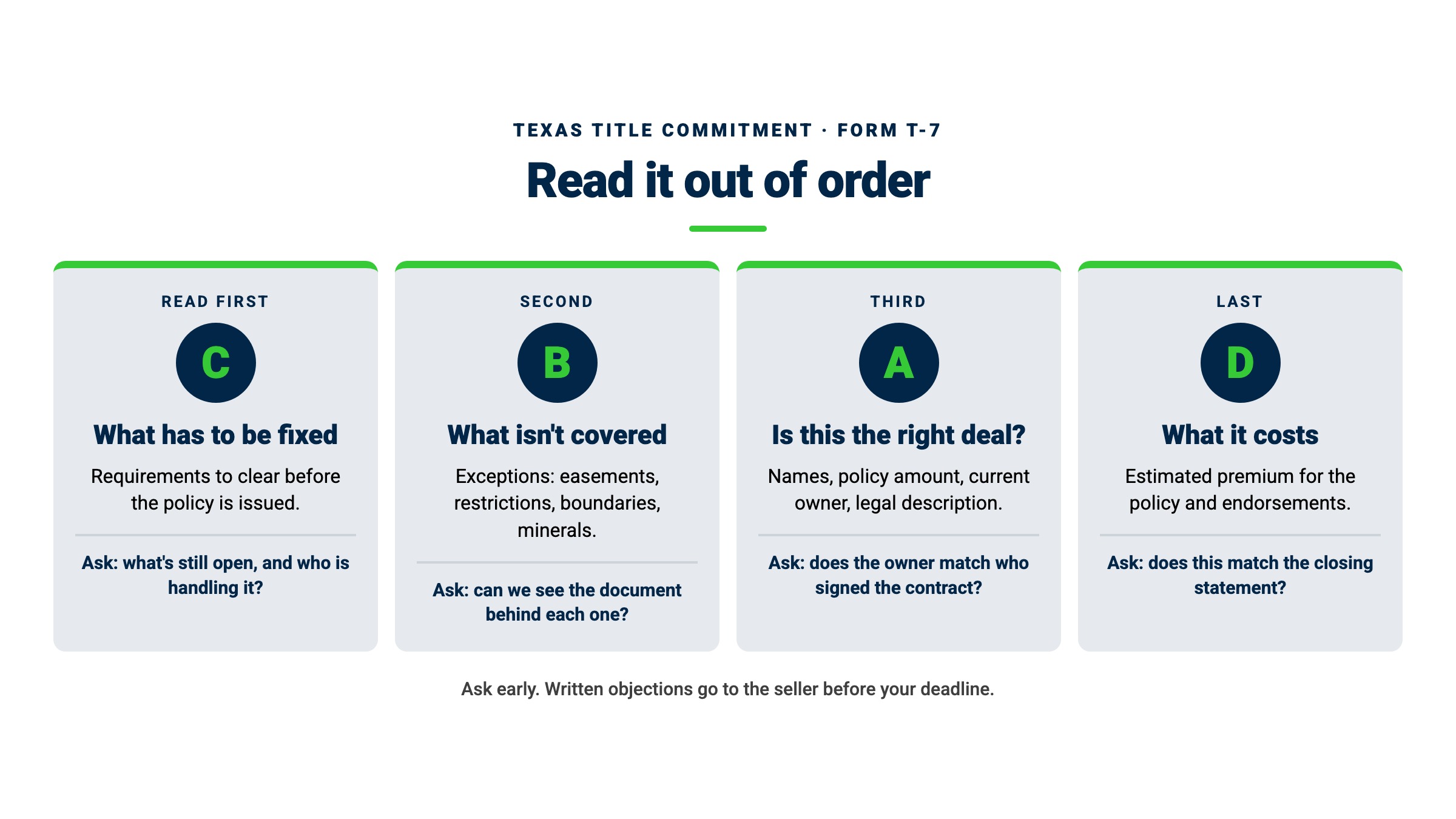
Read it out of order: C, then B, then A, then D
The commitment has four schedules. They're lettered A through D, but we'd read them in the order of what can cost you the most.
Schedule C: what has to be fixed before closing
Schedule C is the to-do list. These are requirements that have to be handled to the title company's satisfaction before the policy is issued.
Some of it is standard on every deal: the documents have to be signed, notarized, and recorded, taxes have to be paid, and contractors who worked on the property have to be paid so no liens attach.
The lines to slow down on are the ones typed in for your property. Common examples: an old loan that was paid off but never released, a lien or a judgment against the seller, a missing signature from an heir or a former spouse, or a divorce or probate that needs paperwork.
This schedule comes first for a reason. The form says that anything on Schedule C that isn't cleared before the policy is issued will show up as an exception on your policy. In other words, an unresolved item on the to-do list turns into something you aren't covered for.
Questions to ask: Who is responsible for clearing each item? What is still open today? Will it be done before closing, or does closing need to move?
Schedule B: what the policy won't cover
Schedule B is the list of exceptions. An exception is a risk that title insurance would normally cover, but won't in your case.
Some are printed on every commitment. Others are added for your property, and those are the ones to slow down on. They usually point to a recorded document: an easement, a set of deed restrictions, a mineral reservation, a lease.
Three are worth understanding in particular.
- Restrictive covenants. These are the recorded rules for the subdivision. If you plan to rent the house by the room, run a short-term rental, park a work trailer, or build a second unit, this is where you find which recorded rules apply. Ask for the document and read it. City rules are separate and won't show up here.
- Area and boundary. The standard wording leaves out problems with boundary lines, encroachments, and improvements that overlap a property line. Think of a fence that sits three feet onto the neighbor's lot.
- Minerals. The form says in bold that minerals and mineral rights may not be covered. On many Texas properties, the minerals were separated from the surface long ago. If that matters for your plans, ask a Texas real estate attorney, because the title policy is not going to answer it for you.
Ask for the documents behind the list. An exception that says "easement recorded in Volume 412, Page 88" tells you nothing until you see where the easement actually runs.
Picture a made-up example. You're buying a house in Corpus Christi with a deep backyard, and your plan is to add a small rental unit behind it. Schedule B lists a utility easement. You pull the document and the survey, and the easement runs right through the spot where the unit would go. That short read just changed your plan, and it's a conversation to have with your agent or attorney while your contract still gives you options.
Schedule A: is this the right deal?
Schedule A is the summary. It lists the policy being issued and the amount, who is being insured, who the records show as the current owner, and the legal description of the land.
Check four things. Is your name, or your company's name, spelled exactly the way you're taking title? Does the owner's policy amount match your price? Is the person or company shown as the owner the same one who signed your contract? Does the legal description match the property you walked?
If the records show the owner as someone other than your seller, there's a story there, and you want to hear it now.
Schedule D: what it costs
The form says the estimated premium for the policy and any endorsements (add-ons to the policy) is shown on Schedule D. Give it a quick look so nothing on your closing statement surprises you. For background, the Texas Department of Insurance has a title insurance FAQ.
The deadline a lot of buyers don't know they have
If you're using the standard Texas resale contract, TREC's One to Four Family Residential Contract, the title section is Paragraph 6. We read the current version of the form, No. 20-19, and here's how it works.
The seller has 20 days after the title company receives the contract to get you the commitment and copies of the exception documents. That time can extend automatically, up to 15 more days or until 3 days before closing, whichever comes first. If it still doesn't arrive in time, the contract lets you terminate and get your earnest money (your deposit) back.
Then your clock starts. You can object in writing to items in the commitment or on the survey, with some limits. Paragraph 6A lists several exceptions you've already agreed to, including the subdivision's deed restrictions and utility easements created by the plat. There's also a blank in 6D where you can write in a use you need, so that anything prohibiting it is something you can object to.
You have to object by the closing date or within the number of days written into a blank in your contract, whichever is earlier. That count starts when you've received the commitment, the exception documents, and the survey.
Miss that window and the contract says you've waived your right to object. There's one carve-out: the requirements on Schedule C are not waived.
One thing that trips people up: an email to the title company asking a question is not an objection. Under the contract, the objection is a written notice to the seller. Your agent or attorney can tell you how to deliver it.
If you do object on time, the seller has 15 days to cure, though the contract doesn't require the seller to spend money to do it. If it isn't cured, you have 5 days after that to terminate and get your earnest money back, or to waive the objection and move forward. Do nothing in those 5 days and the contract treats the objection as waived.
Two more things worth knowing. If the commitment gets revised and something new appears, you get a fresh window to object to the new item. And the contract itself says the commitment should be promptly reviewed by an attorney of your choice, because of these time limits.
This is a separate clock from the option period, which we covered in how to pass on a deal without losing the person who sent it.
If your deal isn't on that form, your deadlines are whatever your contract says. A commercial contract, a new-construction contract, or a creative deal with custom paperwork may give you a different window or none at all. Find the title paragraph the day you sign, and put the deadline on your calendar as soon as it can be counted.

What you can ask for
A commitment isn't final. The form itself lists changes you can request before the policy is issued.
The big one is the area and boundary exception. With a survey the title company accepts, and its other requirements met, you can ask to have that exception amended so the policy covers boundary conflicts, encroachments, and overlapping improvements. The company can still write in exceptions for specific problems the survey shows. On an owner's policy there's an additional premium for the amendment.
The TREC contract has a checkbox for exactly this in Paragraph 6A(8), including who pays. It gets decided when the offer is written, which is one more reason to know what it means before you sign.
Also check the date. The form says a commitment ends 90 days from its effective date unless the policy is issued sooner. If your closing gets pushed, ask whether the commitment needs to be updated, and read the new one when it comes.
Somebody sent you that PDF
This is the part we care about most. That PDF came from a person.
Somebody at the title company put that file together, and answering questions about it is part of the work. Buyers who ask are less likely to be surprised on closing day.
Vin used to own a transaction-coordination company, and we've participated in more than 450 transactions. The way we see it, problems in a deal get fixed fastest when somebody names them early, in writing, to the right person.
So reply to that email. A short note works: "We've read the commitment. Can you send the documents for the exceptions typed into Schedule B, and tell us which Schedule C items are still open and who is handling each one?"
Know what the title company can and can't do. An escrow officer can explain what an item is and what it takes to clear it. They can't tell you whether to accept it. That's a question for your own attorney, and both the state's form and the contract point you there.
Twenty minutes with that PDF pays for itself. You know which exceptions are headed for your policy and which requirements are still open. You have a chance to find the easement, the old lien, or the deed restriction while you still have options. And you start a working relationship with a title office that knows you read the file.

If you're buying in Texas and there's nobody you can text "is this normal?", a Michelle & Vin meetup is a good place to start finding those people. Bring the commitment question you couldn't get answered. We'd love to hear what you're working on.
Disclaimer: This content is provided for educational, informational, and entertainment purposes only. It is not legal, tax, accounting, investment, financial, or professional advice. Michelle and Vin are not acting as your attorney, CPA, financial advisor, or other licensed professional. Every situation is different. Conduct your own due diligence and consult your qualified professional team before making any business, real-estate, lending, investment, legal, tax, or financial decision. Nothing in this article is a promise or guarantee of results.