
The money talk Texas couples need before one of you signs

A question for the married people reading this. If your spouse signed a loan tomorrow morning, would you know what it was tied to?
It usually goes like this. One of you spends three weeks on a deal: walks the property, runs the numbers, talks to the seller twice. The other hears the details on a Thursday night with an answer due by noon Friday.
If you're married in Texas, most of what either of you earns or buys during the marriage is presumed to belong to both of you, whoever's name is on it. So talk before anybody signs, and settle five things together: which money this is, the most you could lose, who is signing what, who runs it, and what would make you stop.
We're partners in business and in life, so it's a subject we care about. We'll start with what Texas law says, in plain English, and then get to the list.
In Texas, "my deal" is usually "our deal"
Texas is a community property state. The Family Code keeps the definition short: community property is the property, other than separate property, acquired by either spouse during marriage.
Separate property is a short list. It covers what you owned before the wedding, what comes to you during the marriage as a gift or an inheritance, and a personal-injury recovery, except the part that replaces earnings lost during the marriage.
Two details catch people off guard.
The first is the starting assumption. Anything either spouse holds during the marriage is presumed to be community property. Whoever says otherwise has to prove it by "clear and convincing evidence," which is a high bar. In practice that means records. If an inheritance lands in the same account your paychecks and bills run through, it can get hard to show later which dollars were which.
The second is income. The statute on managing community property lists "revenue from separate property" as community property. Say one of you owned a rental house before you married. The house can stay separate. The rent it earns is community by default, unless the two of you have agreed otherwise in writing.
Paychecks follow the same definition. Unless you have a written agreement that says otherwise, money either of you earns during the marriage is community property. So a down payment saved out of one person's salary is generally community money, even if it sat in an account with one name on it.
All of this is simply the starting point, and it's the reason a deal one spouse found is still a decision for two.

The name on the paperwork doesn't settle it
A lot of couples assume that whoever is on the deed, the account, or the loan is the one it belongs to. In Texas the name tells you more about who can manage a thing than about who owns it.
Under that same management statute, each spouse has sole management of the community property they would have owned if single, and their own earnings are the main example. Mix that with the other spouse's and it becomes jointly managed, unless the two of you have arranged otherwise by a written power of attorney or another agreement. Property held in one spouse's name is presumed to be under that spouse's sole management, and other people are generally entitled to rely on that.
In plain terms, one of you may be legally able to move money or sign a contract alone. Whether you should is a separate question, and it's the one this article is about.
Debt has its own rules, and they surprise people in both directions.
Being married doesn't, on its own, make you personally liable for a contract your spouse signed. The spousal liability statute says you're personally liable for your spouse's acts only if your spouse was acting as your agent or the debt was for necessaries, and it says marriage alone doesn't make one spouse the other's agent.
But who is personally liable and which property a creditor can reach are two different questions. Under the rules of marital property liability, community property that the signing spouse manages alone, or that the two of you manage jointly, is subject to the liabilities that spouse takes on. So the spouse who never signed may not owe the debt personally, and the joint savings can still be within reach.
The same statute protects in the other direction. The non-signing spouse's separate property, and the community property only that spouse manages, generally aren't reachable for a contract debt the other one took on alone.
Then there's the house you live in. Whether your homestead is separate or community property, neither spouse may sell, convey, or encumber it without the other joining in, with limited exceptions. It's one reason a spouse who isn't on the deed sometimes gets asked to sign at a closing.
How these rules apply to your accounts and your deal is a question for a Texas attorney. What we want you to take from this section is simpler. A signature by one of you can reach things that belong to both of you.
The kitchen-table list
You don't need a law degree for this part. You need an hour, both of you in the room, and no deadline hanging over it.
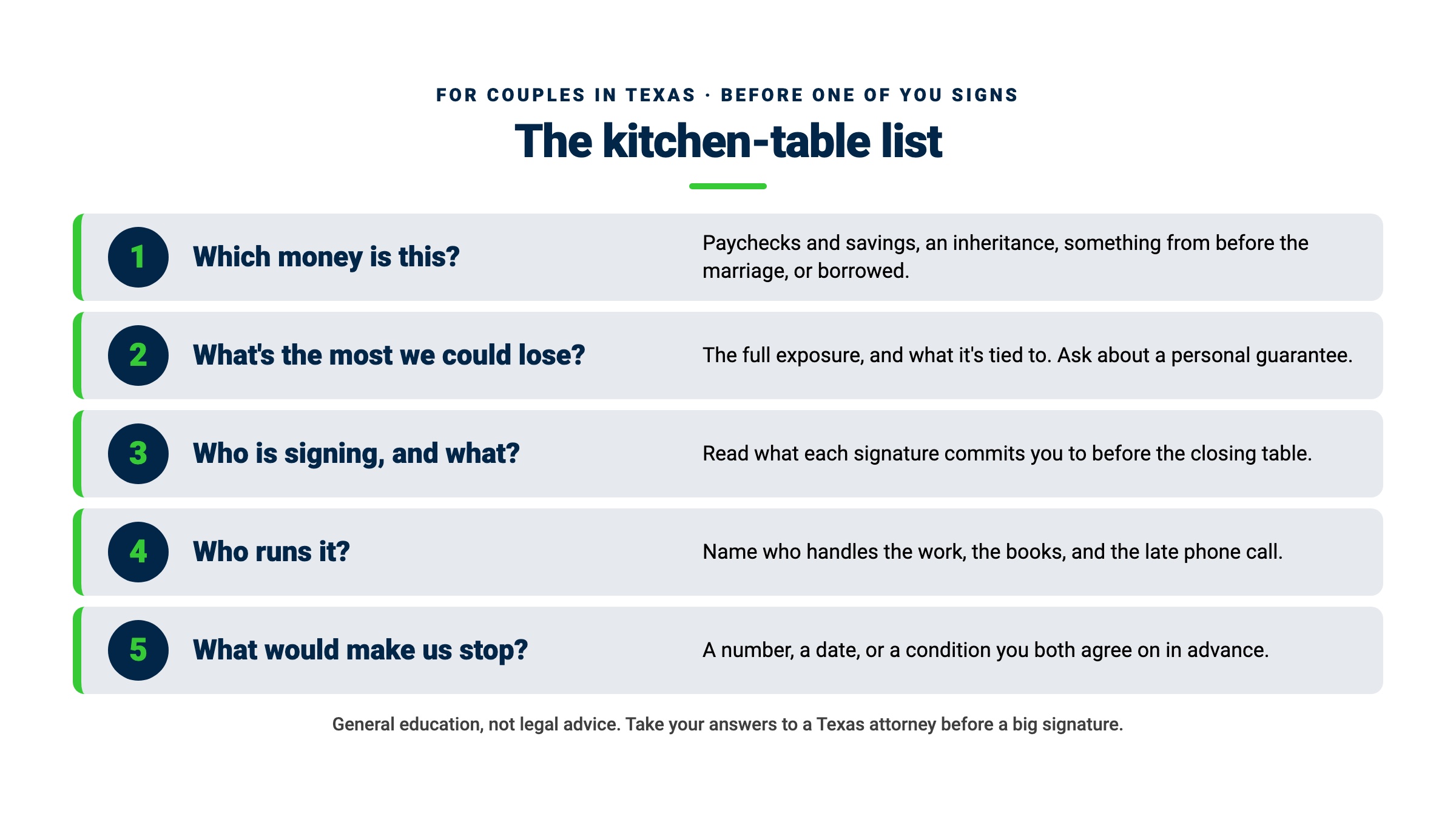
- Which money is this? Paychecks and savings, something one of you brought into the marriage, an inheritance, or borrowed money. If keeping something separate matters to either of you, talk to an attorney before it moves, because where it gets deposited can change how hard it is to trace.
- What's the most we could lose, and what is it tied to? Look past the purchase price to the full exposure. Ask whether the loan comes with a personal guarantee, which is a promise to repay out of your own pocket if the deal or the company can't. We put that on our list of questions to ask a lender before you borrow. Ask whether your home is anywhere in the paperwork.
- Who is signing, and what are they signing? One of you or both. Read what each signature commits you to. If a lender wants both of you to sign, ask what each document is and what it adds.
- Who runs it? A deal takes hours after closing day. Decide who deals with the contractor, who keeps the books, and who picks up the phone at nine at night. Say it out loud so nobody is guessing.
- What would make us stop? Pick the line in advance: a dollar amount, a date, or a condition. A limit you set together on a calm day is much easier to honor than one you're inventing in the middle of a bad week.
Here's a made-up example. A couple in Lubbock wants to buy a duplex. She'd put in money her grandmother left her, and he'd sign the loan.
Question one sends them to an attorney before that inheritance touches the joint account. Question two turns up a personal guarantee he hadn't mentioned, because he assumed every loan had one.
Neither discovery kills the deal. Both are easier to hear on a Sunday afternoon than at the title company.
The spouse who didn't find the deal
We bring different strengths to our own work. Vin's lanes are growth, relationships, and dealmaking. Michelle's are operations, systems, and the details that support relationships. Most couples who build together have some version of that split, and it's useful.
In any couple, the spouse who didn't find the deal is often the best underwriter in the house. Underwriting is the work of testing a deal before money goes in. That spouse isn't attached to the property yet, and tends to ask what a careful lender would ask: what happens if it takes twice as long, and where does the payment come from if it sits empty.
So a slow yes is worth treating as information. When one of you needs more time, there's usually a question underneath that hasn't been answered yet. Find it and answer it.
Two habits worth trying:
- Either of you can say "not yet." A deal that can't survive two more days of questions probably wasn't a fit for your household.
- Write down what you decided. A short email to each other covers it: the money, the limit, who is signing, who is running it. Six months from now you may each remember it differently.
When talking isn't enough
A conversation gets the two of you on the same page. It doesn't change who owns what. For the ownership rules above, that generally takes a written agreement.
Texas lets spouses rearrange things. You can partition or exchange community property so that part of it becomes one spouse's separate property. You can agree that income from separate property stays separate. You can convert separate property to community.
The first two have to be in writing and signed by both of you. A conversion agreement has to be written and signed too, and it has to name the property and say it's being converted.
That last statute also says something many people get wrong. Just putting an asset in your spouse's name, or in both names, is not enough by itself to convert separate property to community property. A transfer like that can still have other legal effects, including being treated as a gift, so ask an attorney before you retitle anything.
Business partners face a similar set of default rules, which we wrote about in you might already be somebody's business partner.
An LLC doesn't settle this for you either. An ownership interest in a company that one of you acquires during the marriage starts under the same presumption as anything else.
This is where a Texas family-law attorney earns the fee, and a CPA if taxes are part of the question. If you married or lived in another state, the rules that apply to you may be different. Texas also recognizes informal marriage, so ask if you aren't sure which rules apply to you.
An hour at the kitchen table gets you a lot. You walk into the deal knowing which money is in it and what's at risk. You both know who is signing and why. And if it goes sideways, you've already agreed where the stopping point is, which leaves the deal as the only hard thing to talk about.
Print the list, sit down with it before the next deal, and bring what you wrote to your attorney.

If the two of you are building something in Texas, come to a Michelle & Vin meetup, and bring your other half even if only one of you "does the deals." Introduce yourselves as a pair. We'd like to know which of you found the last deal and which of you asked the hard questions.
Disclaimer: This content is provided for educational, informational, and entertainment purposes only. It is not legal, tax, accounting, investment, financial, or professional advice. Michelle and Vin are not acting as your attorney, CPA, financial advisor, or other licensed professional. Every situation is different. Conduct your own due diligence and consult your qualified professional team before making any business, real-estate, lending, investment, legal, tax, or financial decision. Nothing in this article is a promise or guarantee of results.