
Nine questions to ask a lender before you borrow

The rate is the least interesting number in the whole loan.
We say that constantly and it still surprises people. Somebody calls, asks what our rate is, and treats that one number as the whole decision. Then the loan closes and the real cost turns up somewhere else: the points, the draw schedule, what happens when the roof takes three weeks longer than the contractor promised.
So, the short version. What a loan costs you is decided by about nine things, and the rate is one of them. The other eight are where deals get expensive. These are the questions we'd want somebody to ask us, and if a lender gets annoyed at any of them, that is itself an answer.
Why the rate misleads people

A rate is easy to compare, which is why it gets all the attention. Two lenders quote twelve percent and eleven percent and the choice looks obvious. Then you find out the eleven percent lender charges three points instead of one, releases the rehab money in four draws instead of two at seven business days each, and charges to extend past six months. On a short project that cheaper rate is the more expensive loan, and it is not close.
Short-term lending is priced across several levers, and moving one down usually moves another up. What matters is the total you'll have paid by the time the property sells or refinances. No headline rate tells you that.
Put two loans side by side and the rate stops mattering
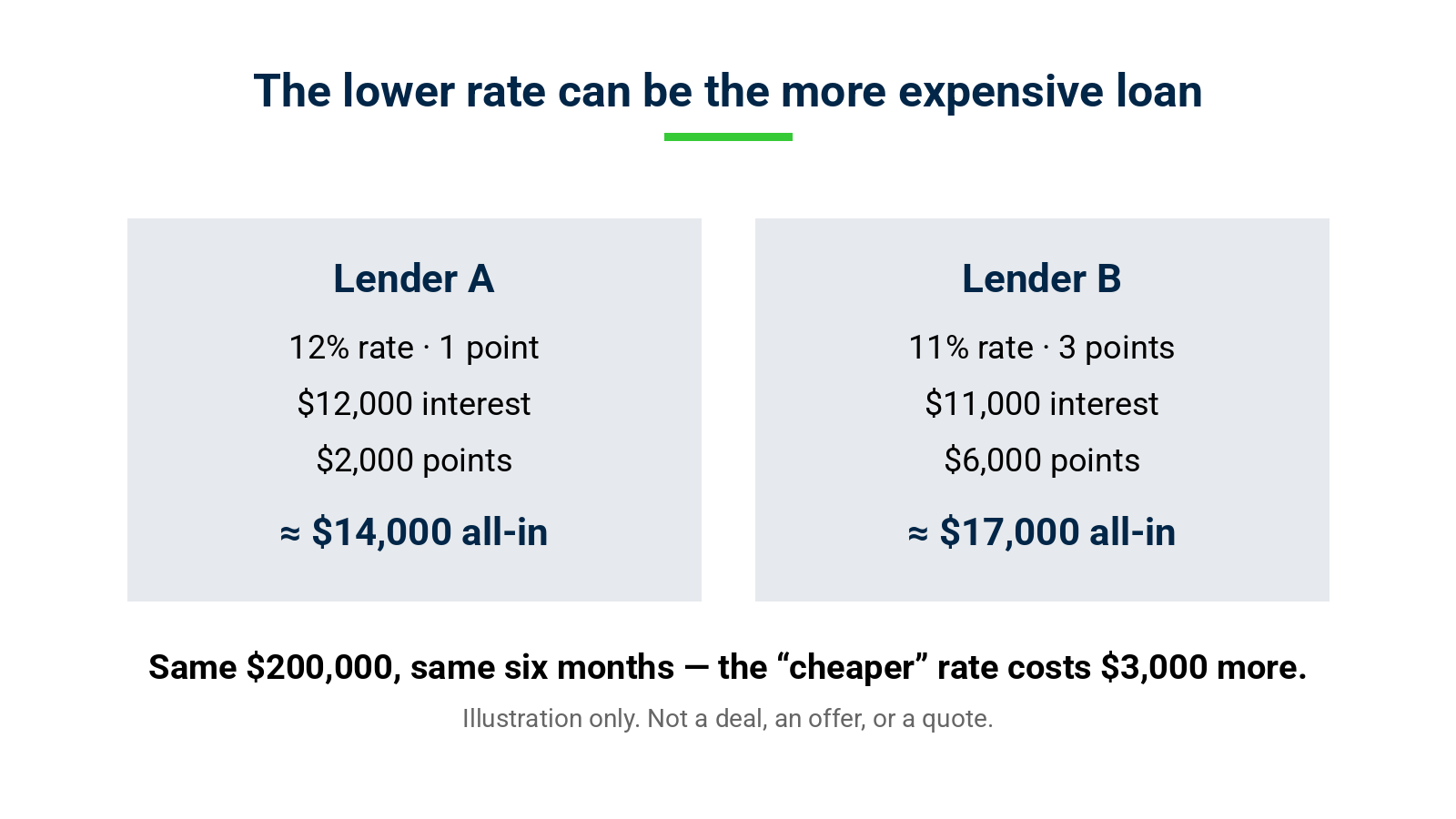
Here's the arithmetic on a made-up but ordinary six month project. Round numbers, illustration only, and your own deal will look different.
Say you're borrowing $200,000 for six months, interest-only, and assume both lenders charge on the whole $200,000 from day one. Hold that thought, because whether it's true is itself one of the nine questions.
Lender A, 12% and one point: about $2,000 a month, so $12,000 of interest, plus $2,000 in points. About $14,000.
Lender B, 11% and three points: about $1,833 a month, so roughly $11,000 of interest, plus $6,000 in points. About $17,000.
The lender advertising the lower rate costs three thousand dollars more, before anything goes wrong.
Now run two months over, which happens all the time. Say Lender A charges a flat $1,000 to extend and Lender B re-charges a point, $2,000, plus the extra interest either way. Lender A lands around $19,000 all in, Lender B around $22,700. The gap widened from three thousand to nearly four.
None of that counts the draw schedule either. Four stages at seven business days against two stages at two days means covering your contractor yourself for several weeks. That cost appears on no term sheet, and you feel every day of it.
Points are not the villain here, and neither is any particular structure. The single fair comparison is the total cost to your exit, and you only get there by asking the other eight questions.
Private money and hard money are not the same thing
Worth clearing up, because the terms get used interchangeably and they behave differently.
Hard money usually means a company lending as a business, with a published process, a team, and a fixed idea of what it will and won't lend on. More predictable, more paperwork, generally faster to say no.
Private money usually means an individual or small group lending their own capital. Terms can be more flexible and decisions quicker, the relationship matters more, and it varies far more from one lender to the next because there's no standard product behind it.
Both are legitimate and plenty of operators use both. Ask the same nine questions either way, since a relationship-based loan with vague terms is still a loan with vague terms.
The nine questions
1. What are the points, and when are they charged?
Points are a percentage of the loan charged as a fee. Two points on $200,000 is $4,000. Ask whether they come out at closing or get added to the balance, because that changes the cash you need on the day. Then the real question: are points charged again if I extend? Some lenders re-charge, some don't, and nobody volunteers it.
2. What is the total cash I need at closing?
Ask for the whole number, not just the down payment: points, origination, doc fees, appraisal, legal, title, insurance, and any interest reserve held back at closing.
Ask for it as a single figure and ask for it in writing. A lender who can't produce that quickly is telling you something about how organized the rest of the process will be.
3. How does the draw schedule work, and how fast is a draw?
This is the one that hurts people, and it's the one they ask about least.
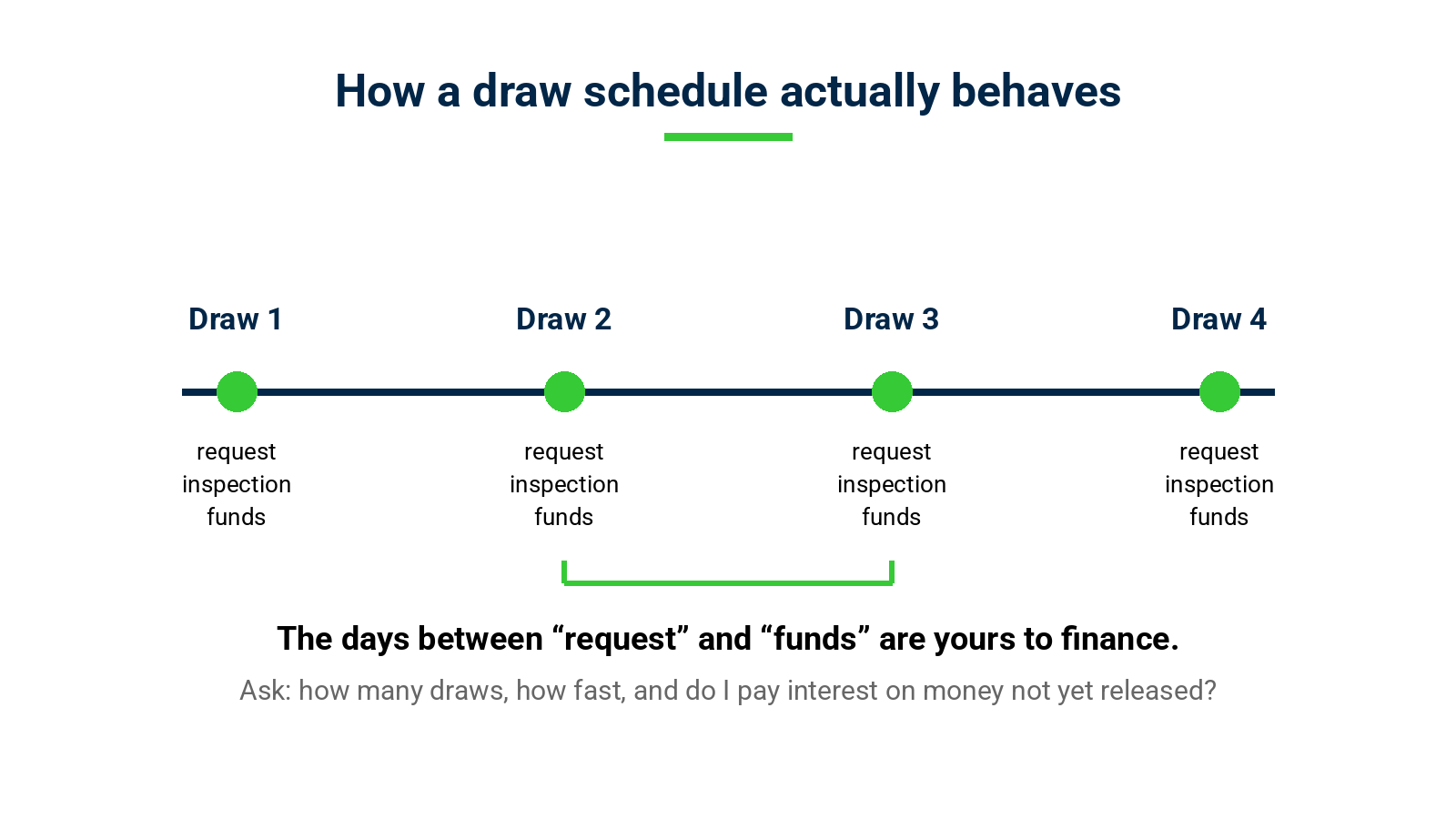
On a rehab loan the repair money usually sits with the lender and gets released in stages as work finishes. Reasonable. But the details decide whether your project runs or stalls:
- How many draws?
- What has to be finished before each one?
- Does somebody inspect, and who pays for that?
- How many days from requesting a draw to the money landing?
- Do I pay interest on the whole loan from day one, or only on what has actually been released?
That last one is the biggest number nobody asks about. If the rehab money sits with the lender and you're paying interest on all of it from closing, you're paying for money you can't spend yet. Some lenders charge that way, some only on what's been drawn, and on a big holdback the difference beats the whole point spread you were comparing. If the answer is "on the full amount", ask whether there's an interest reserve, meaning some of your interest is held back at closing and paid out of the loan rather than out of your pocket.
If draws take ten business days and your crew needs paying weekly, you're financing the gap yourself. Two weeks of that on a big rehab can cost more than a point.
4. What happens if I need more time, and what happens if I default?
Most projects run long. Ask what an extension costs, how long it buys, how many you can have, and whether you have to qualify again.
Then the harder one: what does the rate go to if I default, and what counts as a default? Default interest is routinely far above the rate you signed at, and a missed payment is not the only trigger. A lapsed insurance policy or a blown maturity date can do it. This is the largest surprise cost in short-term lending and almost nobody asks while they still have leverage.
Ask both before you need either. Day 170 of a 180 day loan is a different conversation.
5. Is there a minimum interest period, and what am I personally on the hook for?
Some short-term loans commit you to a set number of months of interest whether you're in the loan that long or not. Flip in four months on a loan with a six month minimum and you pay for six. That can be perfectly reasonable, and it is completely fine when you know about it. It becomes a problem only when you find out at payoff.
Ask too whether you're signing a personal guaranty. Plenty of these loans go to an entity but are guaranteed by you personally, which puts your own assets behind the deal. And ask whether it's written as business purpose, because that affects which rules and protections apply at all.
6. Who actually decides, and who funds it?
Ask whether the person in front of you approves the loan or passes it to somebody else. Ask whether they lend their own capital, a fund's, or whether they're brokering it to a third party.
None of those is wrong. But each adds a layer between your deal and a yes, and layers cost time. When a seller gives you a fourteen day close, time is the whole game.
7. What kills a deal at the last minute, for you?
Our favorite question, and the one that tells you the most.
A lender who has been doing this a while can answer immediately, because they've watched it happen. A title problem nobody caught. An appraisal short of the number. A contractor with no license in that county. An entity document that doesn't match the borrower.
Their answer tells you what to go check today. And a lender who says "nothing really" either hasn't done many of these or isn't being straight with you.
8. What do you need from me, and by when?
Get the document list before you're under contract, not after. Entity documents, bank statements, the scope of work, the contractor's details, insurance, proof of funds for your share.
Deals slip because a borrower spends four days finding a document nobody warned them about. That delay is yours to prevent and it's free to prevent.
9. Can I talk to somebody who's borrowed from you more than once?
A first loan tells you how a lender sells. A second and third tell you how they behave when something goes wrong, and something eventually goes wrong.
Repeat borrowers are the real review. If a lender can't point you at one, that's worth sitting with for a minute.
What good looks like from the other side
We work on both sides of this. We've borrowed, and through Amigos Funding we lend to people borrowing for real estate transactions, so we see the same relationship from both ends. To be clear about the numbers earlier: those were invented for the arithmetic. They are not a quote and they say nothing about what any particular lender, ours included, would offer on a given deal.
What we've learned is that the loans that go well are the ones where both sides were honest early. The borrower flags that the timeline is tight. The lender says draws take a week rather than a day. Nobody discovers anything unpleasant at closing. Clever terms have very little to do with it.
The questions above exist to find out early whether you and this lender will communicate well once the project gets difficult, because it probably will. Catching somebody out is not the point. A lender who answers all nine clearly and without irritation is showing you how they'll behave in month four.
And it works in the other direction. When somebody comes to us having already thought about their draw schedule and their exit, we take them more seriously, because they've shown they've thought past the purchase.
Before your next call
Take the nine questions with you and write the answers down rather than trusting your memory of a phone call. Then put your two or three lenders side by side and compare the total cost to your exit rather than the rate.
If the numbers land close, go with whoever answered question seven best. Terms compare on a spreadsheet. How somebody behaves when a deal goes sideways, you can only infer from how straight they were before it did.

Coming to the next meetup? Bring the loan you're considering. There are usually people in that room who have borrowed for the exact thing you're about to do, in the same Texas markets, and half an hour with one of them beats any article including this one. Dates and details: vinandmichelle.com/meetup
Or bring the project to us and ask us the nine questions directly. What we won't do is tell you whether to sign somebody else's paperwork; that's a conversation for you and your own attorney.