
The call you do not want to make when a project is behind

There's a specific Tuesday afternoon that everybody who has ever run a project with borrowed money knows. The framing inspection didn't pass. Or the plumber has gone quiet, or the material you ordered in June is now eleven weeks out, and you're doing the arithmetic in your head and realizing the date you promised somebody is no longer a date you can hit.
And the first instinct is almost always the same one. Wait. Not forever, just a week. Get the inspection rescheduled, get a firm answer out of the supplier, then make the call with a solution attached instead of a problem.
We'd tell you to do the opposite, and here's the whole argument in one line.
Make the call before you have the solution, because the waiting is what does the damage, not the news.
A project running four weeks late is a normal event. A partner who finds out about it in week five, after asking twice how things were going, is a different event entirely, and it's the second one that ends relationships. We work on both sides of this — we borrow on our own projects, and through Amigos Funding we lend to people borrowing for real estate transactions — and the pattern is consistent enough from both chairs that we'd call it a rule.
Why waiting feels responsible
Nobody delays the call out of dishonesty. They delay it out of a fairly decent instinct: don't hand somebody a problem you haven't tried to solve yet.
That instinct works beautifully inside your own business. It's how you avoid dragging your partner into every small fire. Applied to somebody whose capital is sitting in your project, it backfires, because you're solving for the wrong thing. You're trying to protect them from worry. What they actually need is time to make their own decisions.
A lender or capital partner who learns in week one that you're going to be a month late has options. They can adjust their own planning, tell whoever they answer to, and decide whether they want to help you fix it. The same person learning the same fact in week six has one option, which is to react.
The other thing worth understanding is that silence is never read as neutral. When a project goes quiet, nobody on the outside thinks "must be going fine." They think about the last time somebody went quiet on them. You aren't buying yourself time by waiting. You're spending somebody else's trust to buy it, and it's an expensive way to pay for a week.
What the person on the other end is actually worried about
It's worth being specific here, because most people making the call are braced for the wrong conversation. They expect anger about the delay. Delay is rarely the thing.
In our experience there are three real concerns, roughly in this order.
Whether the money comes back at all. Timing is secondary to principal. Most of the tension in these conversations is about whether the capital is still there, and a lot of it settles the moment you show that you still understand your own numbers.
Whether they're going to be surprised again. One surprise is a project. Two surprises is a pattern, and a pattern means they can't rely on anything you tell them, which is a much bigger problem than a late roof.
Whether they're hearing it from you first. Finding out from a contractor, a title company, or somebody at an event is close to unrecoverable. It converts a delay into a question about character, and you don't get to argue your way back out of that one.
Notice that two of those three have nothing to do with the project and everything to do with the conversation. That's the part you control completely, on a day when you control very little else.
The update that works
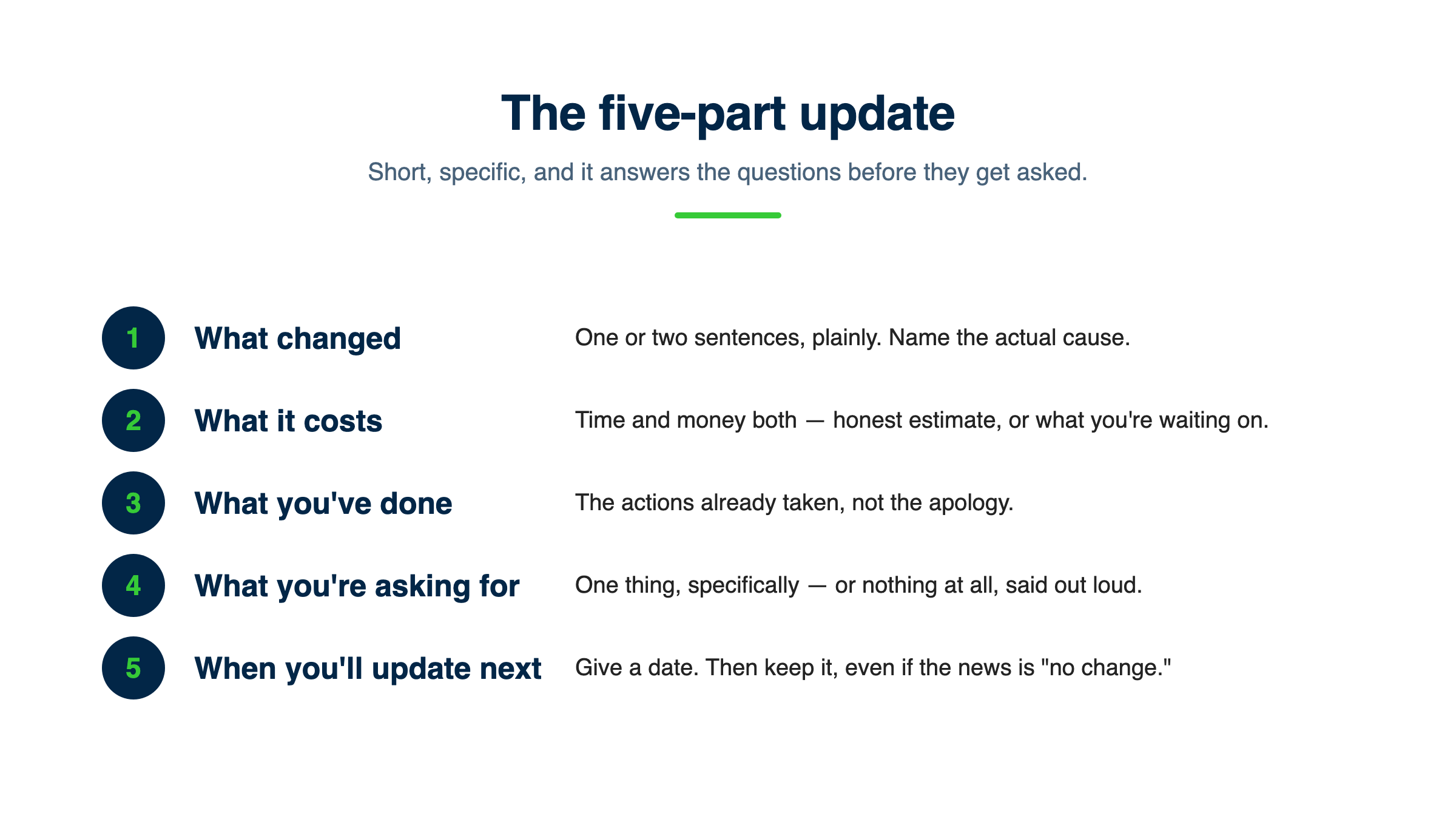
A good bad-news update is short, specific, and answers the questions before they get asked. Five parts, in this order.
- What changed. One or two sentences, plainly. "The city kicked back the electrical permit and we're in a queue" beats "we've hit some delays with the municipality."
- What it costs. Time and money, both, with your best estimate and the word "estimate" in there honestly. If you don't know yet, say what you're waiting on and when you'll know.
- What you've already done about it. The actions, not the apology. Called the inspector, sourced a second supplier, moved the flooring crew up so the delay overlaps instead of stacking.
- What you're asking for. One thing, specifically, or nothing at all. "I'm not asking for anything right now, I just wanted you to know early" is a complete and respectable ask.
- When you'll update next. Give a date and then keep it, even if the update is "no change." Especially if it's no change.
That last one is doing more work than it looks like. Confidence gets rebuilt by the second and third update landing exactly when you said they would, long before the project itself recovers. You're proving that your word about small things still holds, which is the only available evidence that your word about big things does too.
What to leave out matters just as much. Skip the blame narrative, skip the long explanation of everything that went wrong upstream, and skip any prediction you aren't confident you'll hit. A recovery date you invent to make one phone call easier becomes the next thing you have to walk back, and now you're two misses deep on a project that only actually went wrong once.
Ask for one thing, and know what happens if the answer is no
If you do need something, be concrete about it. Vague requests put the other person in the position of designing your solution, and most of them will decline that job politely by doing nothing.
Usually the ask is one of three: more time, restructured draws so your cash flow survives the delay, or additional funds to finish. They're not equivalent. More time is often the easiest conversation. Additional funds is a new underwriting decision, and it's fair to expect it to be treated like one, with fresh questions and possibly a different answer than you'd like.
Before you ask, do the thing almost nobody does: work out what you'll do if they say no. Keep it to yourself — this is for your own clarity, not a card to play on the call. Can you fund the gap yourself, reduce the scope, list it as-is, bring in a partner? An operator who has already thought that through sounds completely different from one who hasn't, and the difference comes through fast.
Two things to be careful with. Don't promise an outcome you can't control — that includes what a buyer will pay, what an appraiser will say, or when a city will act. And don't assume any lender or capital partner will grant an extension or a modification just because the request is reasonable. Those decisions belong to them, they depend on their own documents and constraints, and anything that changes a loan or an agreement needs to be in writing with your own attorney's eyes on it. A friendly phone call is not an amendment.
One more case worth covering, because it causes most of the hesitation: what to send when you don't have news yet. You know something has slipped, you don't know by how much, and calling to say you don't know feels absurd.
Send it anyway, shaped around what you're waiting on rather than what you're guessing at. "The permit is in review, the office says they're running three to four weeks, I've asked for that in writing and I'll know more by the fourteenth." That's a complete update. It resolves nothing and it still beats silence, because it tells the other person what the next decision point is and when it arrives.
The trap is estimating to fill the gap. Saying "probably ten or fifteen thousand" because the pause felt awkward creates a number that gets remembered and quoted back to you. Honest ranges are fine. Comfort figures are not.
Why the uncomfortable version is worth it
When a project is running clean, every operator looks the same. Everybody returns calls, everybody sounds organized, and there's nothing to separate the person who handles trouble well from the person who disappears into it. The overrun is the only time that difference is visible, which is a hard thing to accept while you're standing in one.
The delay itself is already a fact and you can't argue with it. What's still open is what the people around this project learn about how you behave when the plan stops working, and that part follows you into the next deal and the next partner. Capital tends to move toward people who stay steady when things go badly, because that's the only condition under which steadiness is worth anything.
So if a project of yours is drifting right now and you've been putting off the message, write the five parts down before you talk yourself out of it. What changed, what it costs, what you've done, what you're asking for, when you'll update next. Then read it out loud to somebody who isn't holding your note — not for reassurance, for editing. Let them tell you which sentence sounds defensive and which number you're being vague about. Then send it, and keep the next update on the day you promised.

If there's nobody you'd read it to first, that's worth fixing on a week when nothing is wrong. Our monthly meetup is free and full of investors, lenders, contractors and operators around Texas who have had projects go sideways and are unusually willing to say so out loud. Nobody there needs anything from you. Details are at vinandmichelle.com/meetup.
Build that bench on a quiet week. You'll use it on a loud one.