
What we'd want to know before lending on somebody else's deal

Somebody you know has a deal. They need money faster than a bank moves, they're offering you a return that sounds good, and they want an answer this week.
Here's the thing worth sitting with before anything else. A good return on a bad deal is still a bad deal. The rate you're quoted tells you what somebody hopes to pay you. It tells you nothing about whether you'll get your money back, and those are completely different questions.
What follows is the order we'd look at things in. It isn't legal or investment advice, and you should have your own attorney and your own professionals look at anything real. It's the thinking, not the paperwork.
The order we'd look at it in
Three passes, in this order. Most people do them backwards and start with the return.
First, the deal itself
The instinct is to look at the number first. Resist it for ten minutes.
If the deal works, a fair return is achievable. If the deal doesn't work, no promised rate saves you, because the money to pay you has to come from somewhere and that somewhere is the property.
So look at the property before you look at the offer:
- What did they pay, and what is it actually worth today? Not after repairs. Today.
- What's the repair budget, and who produced it? A contractor's written scope is worth more than the borrower's estimate.
- What's it worth when the work is done, and who says so? An appraisal or a broker's opinion beats an opinion.
- How do they get you paid? Sale, refinance, or something else. Ask which, and ask what happens if that route closes.
Then work out how far the deal can fall before you're the one absorbing it. If somebody wants $150,000 against a property worth $200,000 today, the property would have to lose about a quarter of its value before it is worth less than you are owed — and remember you are owed more than you lent, once interest and costs pile up. If they want $190,000 against the same property, almost nothing has to go wrong for you to be underwater.
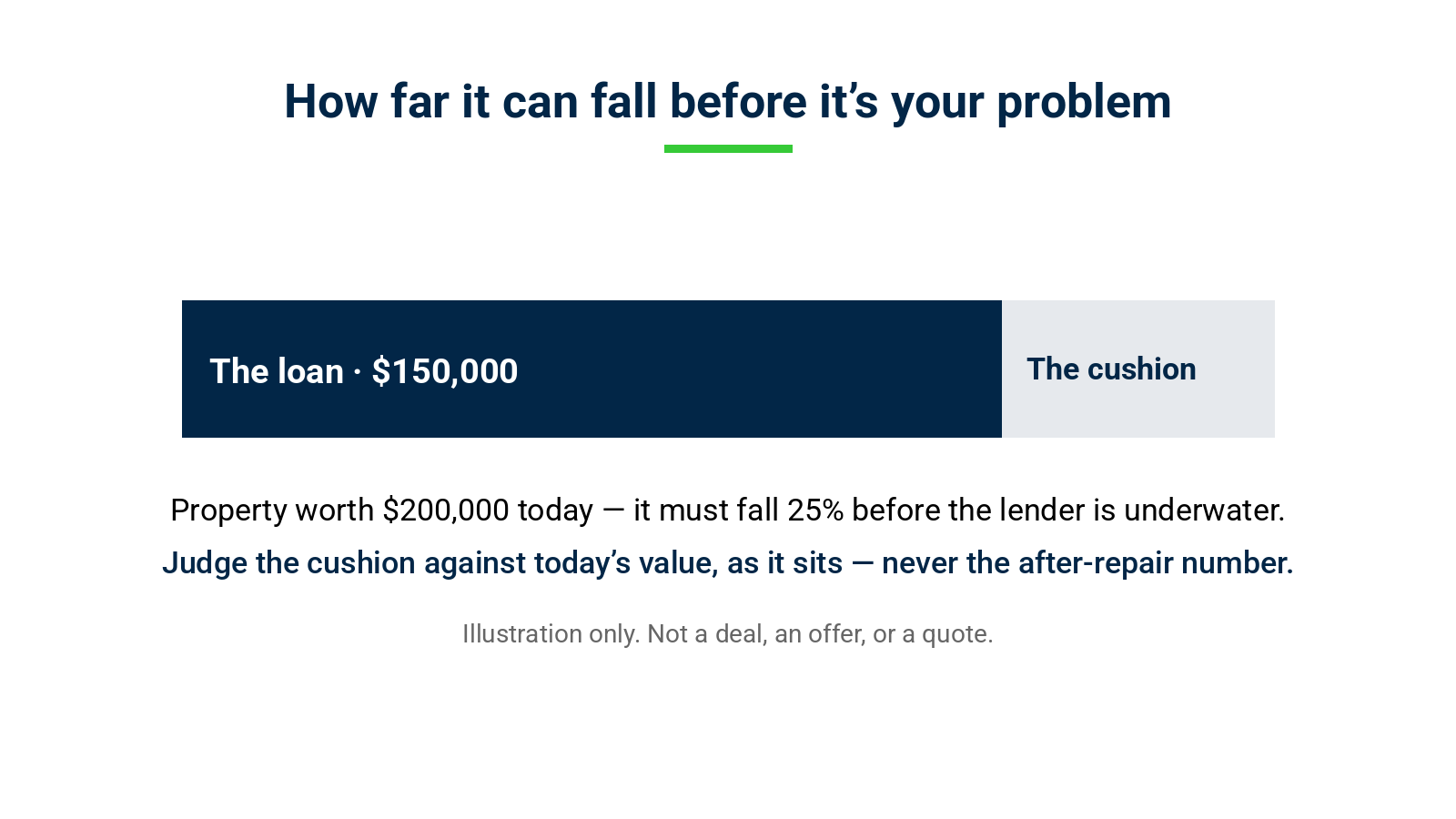
That cushion is the single most useful number in the whole conversation, and it's rarely the one being advertised.
Two things people get wrong when they work it out. The first is using the after-repair value instead of today's value. The repairs might not happen. If the borrower runs out of money in month three, you are holding a half-finished house, and a half-finished house is worth less than the one they bought, not more. Judge your cushion against what you could sell it for this week, as it sits.
The second is forgetting that getting your money back has its own costs. If you ever have to take the property, you'll have legal fees, carrying costs, insurance, possibly finishing the work, and then selling it. Knock a meaningful amount off whatever you think the property is worth before you call the cushion comfortable.
Second, what actually protects you
There's a large difference between lending money to somebody and lending money against something, and plenty of people find out which one they did at the worst possible moment.
Ask, plainly:
Am I recorded against the property, and in what position? A lien recorded in first position means you're ahead of the other recorded lenders if the property is sold or foreclosed. Second position means somebody else is ahead of you and gets paid first. Both are real, but they are not the same risk, and the return should reflect which one you're taking.
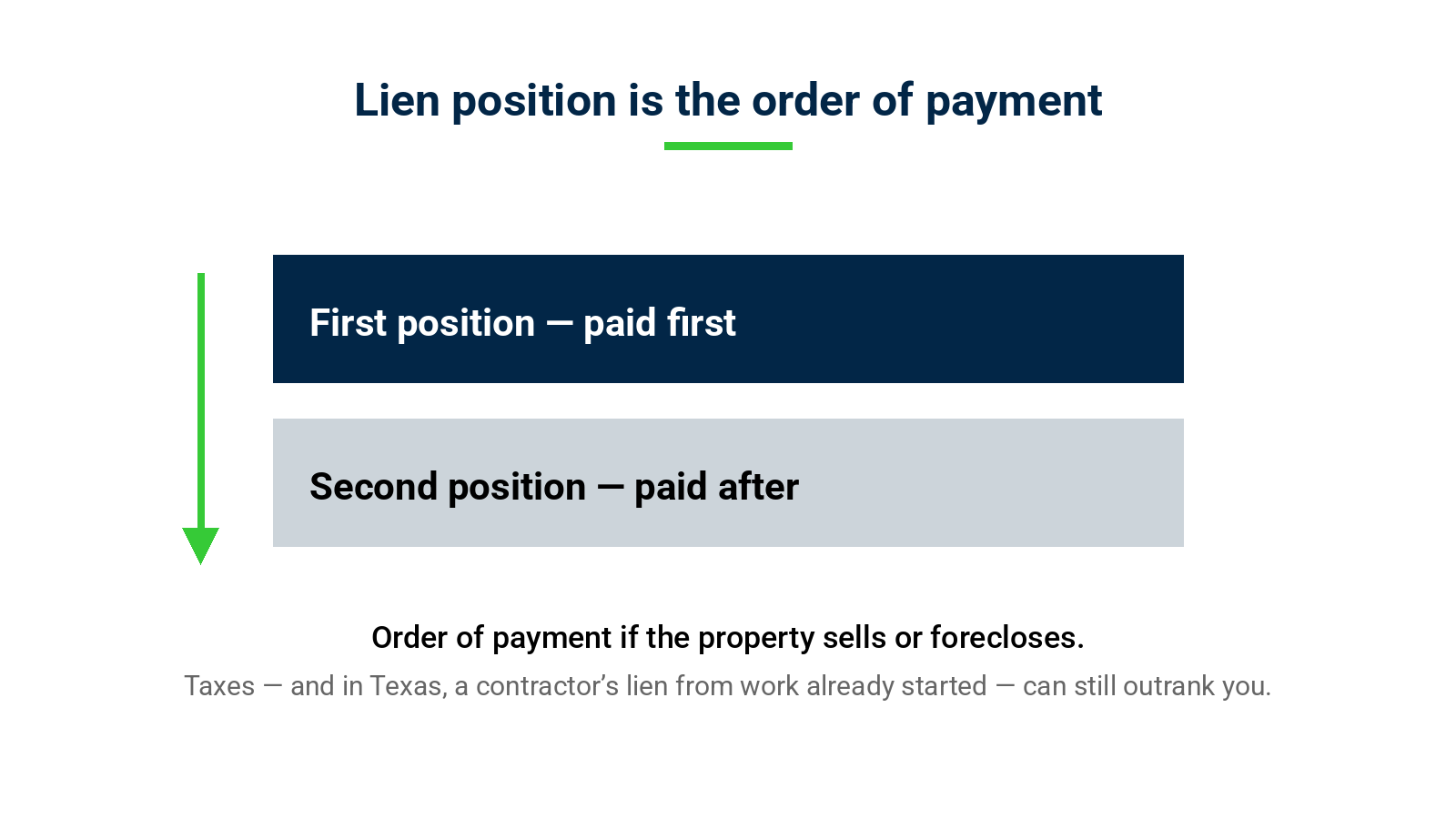
And then the part almost nobody asks about: first position is a position on the record, not a promise that nothing can get in front of you. Unpaid property taxes outrank you. And in Texas, a contractor's or supplier's lien can take its priority from the date visible work started or materials were delivered — which can be before your lien was ever recorded. On a rehab deal, where a crew may already have been on site, that is the most common way somebody who was promised first position discovers they are actually second. So ask plainly: has any work started, or has any material been delivered, on this property? Then put that question to the title company and your own attorney before you fund, not after.
Is there a title policy that covers me, specifically? This one gets misunderstood constantly, so it's worth being precise. The policy that insures the buyer's title is the owner's policy. It does not insure your loan, and asking to be "named on" it does not change that. What protects a lender is a separate lender's policy — sometimes called a mortgagee policy or loan policy — issued in your name, in the amount of your loan, insuring that your lien is recorded where you were told it would be. Ask whether one is being issued, who pays for it, and ask to see it. If the answer is that there's a title policy and you're covered by it, that is not yet an answer.
Is the property insured, and how am I attached to the policy? Again, being "listed" is vague. What you want is a standard mortgagee clause naming you. It does more than get your name on a check: it gives you your own contract with the insurer, so your coverage survives things the borrower does that would void theirs — a misstatement on the application, or worse. It also obliges the insurer to tell you before the policy lapses. (On collateral that isn't real property, the equivalent is a lender's loss payable endorsement — related, but not the same thing.) Ask for the declarations page showing it, not a verbal assurance. If the house burns down and you aren't properly attached, the money can go to the borrower and you are left holding a note.
What documents will I actually hold? At minimum a promissory note saying what's owed and on what terms, and a recorded lien. Handshakes and text messages are not documents.
Who is the borrower — a person or an entity? If it's an entity, ask whether anybody is personally guaranteeing it. If nobody is, the entity is the only thing you can pursue, and an entity can be worth very little.
Am I the only lender on this, or is my money going into a pool? This question changes the whole character of what you're being offered, and it is the one most often skipped.
A direct, one-to-one loan you make yourself, secured by a lien recorded in your name against a specific property, is generally treated as a loan rather than a securities offering. You can see the collateral, you hold the documents, and you can act on your own. But that is not automatic either, and it is a question for a securities attorney rather than one to settle over coffee.
Being asked to put money into a fund, a joint venture, a partnership, or any arrangement where your money is combined with other people's and somebody else decides what happens to it — that is a different thing. Arrangements like that are frequently securities, and securities are regulated at both the federal and state level regardless of how informal the conversation was or how well you know the person. There are rules about who may be offered one, what must be disclosed, and how it may be advertised.
You do not need to work out where that line falls yourself — that is a lawyer's job. But the person raising the money absolutely does need to have worked it out already. What you need is to ask the question — is this a loan directly from me to you against this property, or am I one of several people going into something together? — and if it's the second, to have a securities attorney look at it before you send money. That is not a hostile question. Somebody running a legitimate pooled offering will already have counsel and will answer it immediately. Somebody who waves it off has told you something important.
Two Texas questions to settle before you quote anybody a rate. First, what interest rate am I actually allowed to charge on this kind of loan? Texas caps interest, and the starting point is a lot lower than most people assume — the general default is in the single digits, and the higher ceilings people have in mind only apply when the loan qualifies for them and is documented to match. Whether yours does turns on the specifics. Going over the line is not a slap on the wrist: the penalty is a multiple of the excess interest, which can be more than the deal ever made. Second, does lending against this particular property require me to be licensed? Lending against somebody's home can pull you into residential-mortgage licensing rules that do not apply to a commercial deal.
Both answers turn on the specifics — whether it's business-purpose, what the property is, who occupies it — which is exactly why they belong with your attorney rather than in an article. Ask before you name a number, not after.
One more worth asking: who prepares the documents, and does my own attorney get to read them before I sign? Very often the borrower's attorney draws everything up, which is normal and fine, but those documents are written to protect the borrower. Having your own person read them is not an insult to anybody. It is the cheapest part of the whole transaction.
None of this is unusual to ask. Anybody who has borrowed private money before will have the answers ready and will expect the questions. Somebody who finds them offensive is telling you something useful about how the rest of the relationship would go.
Third, the person
Documents matter most when things go wrong. The person matters most in whether things go wrong at all.
Have they done this exact thing before? Not real estate generally. This kind of project, at roughly this size, in roughly this market. Somebody excellent at buy-and-hold rentals is not automatically good at a heavy rehab.
What happened the last time one went badly? Everybody who has done enough deals has had one go wrong. What you want is a straight story about what happened and what they did. Somebody who says nothing has ever gone wrong has either done very few deals or is managing your impression.
Can you speak to somebody who lent to them before? Same principle as the borrower side. A first lender learns how somebody sells. A repeat lender knows how they behave under pressure.
How do they communicate when there's nothing to report? Ask what you'll hear and how often, and agree it up front. A monthly note saying "still on schedule, here are two photos" costs the borrower ten minutes and is worth an enormous amount to whoever's money is in the wall. The worst experience in private lending is rarely losing money. It's the silence while you don't know whether you're losing money.
And know what happens if they simply stop paying
This is the part almost nobody thinks about while they're excited about a deal, and it's the part that decides how bad a bad outcome gets.
If a borrower stops paying, you do not get the house on Friday. There's a legal process, it varies by state and by the type of property, it takes time, and it costs money. Ask a Texas real estate attorney what that process actually looks like for the specific kind of loan you're being offered, and ask before you lend rather than after. An hour of their time now is worth considerably more than the same hour once something has gone wrong.
While that runs, several things are true at once. You're not being paid. Somebody has to keep the insurance current or you have an uninsured asset. Property taxes keep accruing, and unpaid taxes can jump ahead of your lien. If the borrower has stopped answering, you may not know the condition of the property.
None of that means don't lend. It means know what the bad version costs you in time, money and attention, and price the risk with that in mind rather than pretending the collateral converts to cash on demand. It also explains why the cushion matters so much: it's what absorbs all of this.
The people who do well lending privately are the ones who thought through the bad outcome before they wired anything, and were content with it.
The answers that would stop us
Some responses aren't red flags so much as the end of the conversation:
- "Don't worry about the paperwork, we'll sort it after." No.
- Pressure on timing. Real deadlines exist and good operators explain them calmly. Urgency used as a tool to stop you checking things is different, and you can feel the difference.
- A return well above what similar deals pay, with no explanation of the extra risk. Higher return means higher risk. If somebody can't tell you what the extra risk is, either they haven't worked it out or they aren't saying.
- Vagueness about position. "You're protected" is not an answer. First or second is an answer.
- Vagueness about whether it's a loan or an investment. If you can't get a straight answer to whether your money is being pooled with other people's, stop there. That distinction decides which body of law applies to the whole thing.
- Any version of "it's guaranteed." Nothing is. Anybody using that word about a real estate deal is either careless with language or careless with your money, and neither is what you want.
- You can't visit. You should be able to see the property, or send somebody.
Getting comfortable takes longer than one conversation
The thing we'd most want somebody new to this to hear is that there's no rush.
A deal that only works if you decide by Friday is a deal you're being asked to underwrite on somebody else's schedule. Good operators come back with the next one. There's always a next one.
Take the time to read the documents. Pay your own professional to look at them, which will cost a fraction of what a bad first loan costs. Ask the questions above and pay attention to how somebody handles being asked, because that is the actual information.
We have sat in the other chair — asking somebody to trust us with a project, and borrowing private money to do it. The relationships that lasted were always the ones where the questions came early and got straight answers. When these go wrong, it is almost never about the numbers.

If you're weighing something up
Come to the meetup and bring it. There are usually people in the room who have lent on this exact kind of project in Texas, and some who have had one go sideways and will tell you about it honestly. That is worth more than any checklist. Come sit in on one: vinandmichelle.com/meetup
To be clear about what that is and isn't: we're glad to talk through the framework in this article and how other people have approached the same decision. We don't review anybody's opportunity, we don't tell anybody whether to lend, and we're not offering anything to invest in. The decision on a specific deal belongs to you and the attorney, CPA and advisors you pay to look at it — and on something like this, you should have all three.