
What we'd do in our first ninety days in a market where we don't know anybody

Day one in a new market looks the same for everybody. You have money, you have skill, and you have nobody to call.
That last part is the whole problem, and it is the part people underestimate — because the money and the skill are the bits that took years to build, so it feels like the hard work is behind you. It isn't. You are ninety days of unglamorous groundwork away from being able to act, and the people who lose money in a new market are almost always the ones who skipped it.
So: spend your first ninety days buying information and relationships instead of property. Day ninety should end with you able to drive a street and defend an opinion about what things are worth on it, and with a handful of people who pick up when you call. No deal required.
Below is the ninety days, split three ways. It assumes you already know how to do the work — this is only about learning to do it here. (If what you actually need is how to walk into a room full of strangers and come out with something, that is a different problem and we wrote about it separately — how to leave a real estate meetup with something real.)
What you can't bring with you
Skill is portable. Almost nothing with a street address attached to it is.
You already know how to analyze a deal, run a rehab, and keep your word. None of that tells you what a framer charges in this county, which supplier will actually have material in stock this month, which school boundary moves a price, which neighborhood is three years into a change and which one has been "about to turn" for a decade, or whether that flooding is a once-a-decade problem or an every-spring one.
That list is not knowledge you can study. It is knowledge that lives in people who already work here, which is why the next ninety days are mostly about finding them.
One more thing worth saying out loud before you start: the strategy that was right in your old market may not be the right one here. Arriving determined to run one exact playbook decides the answer before you have seen the question. Our own work in Texas ended up spanning buy-and-hold, private capital, lending and furnished housing — we are not going to tell you yours will change, only that you should let the market get a vote.
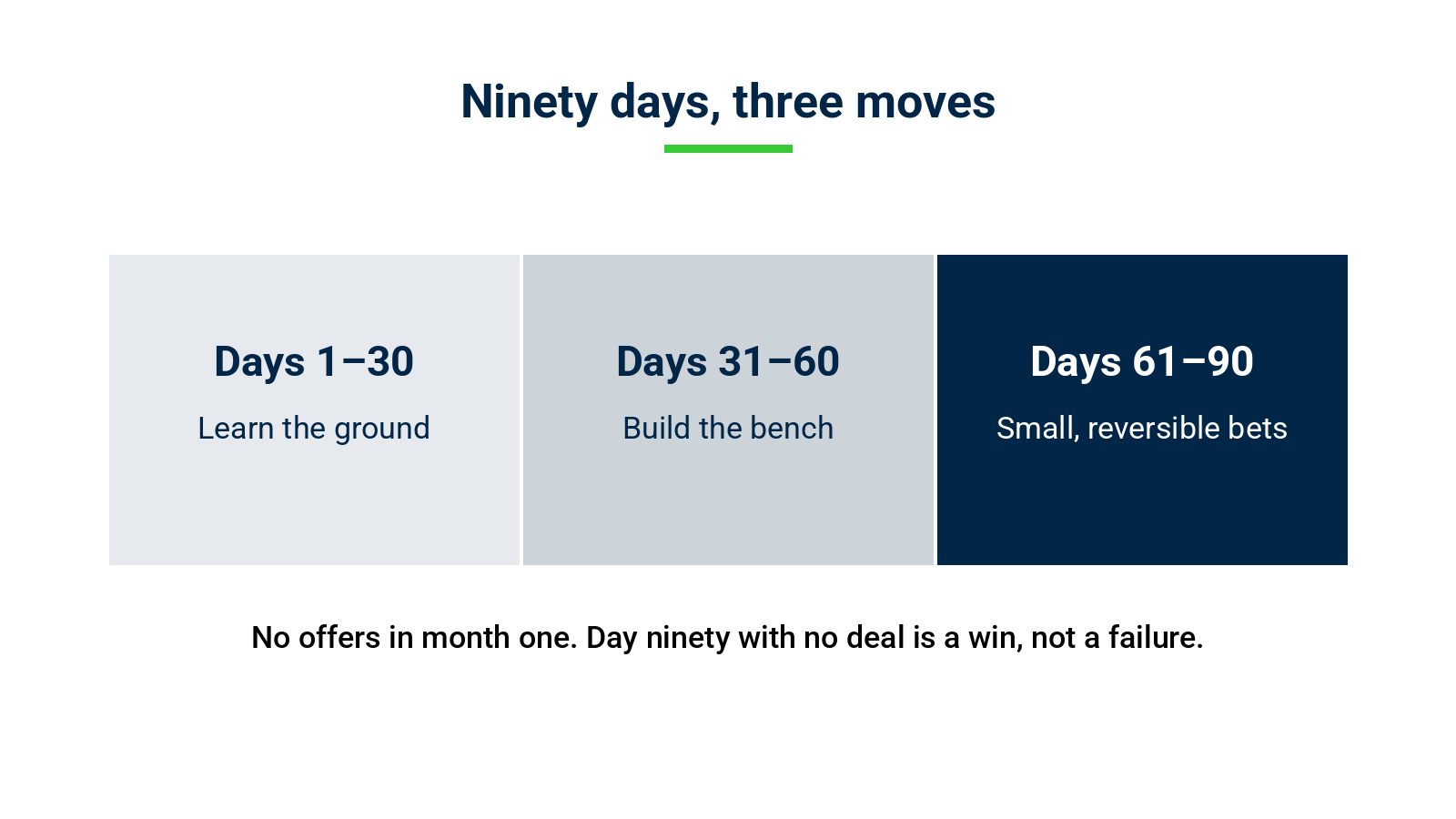
Days 1–30: learn the ground, not the deals
Pick a geography and make it embarrassingly small. Not a metro. Not even a side of town. Pick something you could drive in forty minutes, and drive it until it's boring.
Then go and get the local facts that nobody's podcast can give you. If you're coming to Texas, two of them will trip you up.
Texas doesn't publish what things sold for
Texas is a non-disclosure state. Sale prices are not public record here. In California, Florida and most of the country you can look up what a house sold for; in Texas the county records the transfer, not the number. That's also why the big listing portals can't show sold prices here the way they do elsewhere. (Texas shields sales information given to appraisal districts in confidence — Tex. Tax Code §22.27 — which is why no public database carries the number.)
Be precise about what this does and doesn't mean, because the internet overstates it. You can pull the county appraisal district's appraised value for almost any parcel, free, online — and you should. But an assessed value is not a sale price, and the sale price is the number you're underwriting against. Title companies, lenders and appraisers see it. The public doesn't.
So the number you most need has to be handed to you: by an agent with MLS access, by an appraiser, by somebody who bought three doors down. In a disclosure state you can teach yourself the comps from your laptop. Here, a real part of your comp set arrives through people who have a reason to help you. That changes what "networking" is worth in Texas, and it's the single best argument we know for doing the next section properly.
Property taxes are a bigger line than you think
Texas has no state income tax and leans on property tax instead, so it lands harder in your underwriting than newcomers expect. Two traps in particular.
Don't underwrite using the seller's tax bill. The assessment can move after a sale, and any exemption the seller had — a homestead exemption, for instance — is theirs, not yours. Underwrite the taxes you will pay.
Know the protest deadline before you need it. It is set by statute and is the same in every county — no hunting for a local rule. The statute says May 15, or 30 days after the appraisal district delivers your notice of appraised value, whichever is later, and the Comptroller's own guidance measures those 30 days from the day the notice is mailed (Texas Comptroller) — so treat the mailing date as your clock and you'll always be early rather than late. Miss it and you have generally lost that year. Put it in the calendar the week you close. (Other kinds of protest carry their own deadlines; ask if yours isn't about the value.)
Both of these are worth an hour with a local CPA or property tax consultant. It's cheap advice and it compounds every year you own the thing.
What day 30 looks like: you can name your streets, you have a rough cost per square foot for a standard rehab, and you know what taxes and insurance actually run on a property like the ones you're targeting. No offers yet. None.

Days 31–60: build the bench before you need it
Here's the list. Find and vet each of these before a deal is on the clock, because every one of them becomes an emergency if you wait:
- An agent who invests themselves, not just one who sells houses
- A lender — and a second one, so you're never negotiating against a single option
- A title company that has closed the kind of structure you actually use
- An inspector
- An insurance agent who understands non-owner-occupied and vacant coverage
- A general contractor, plus two independent trades you could call directly
- A property manager, even if you don't plan to use one yet
- A real estate attorney licensed in the state
- A CPA who knows this state's rules
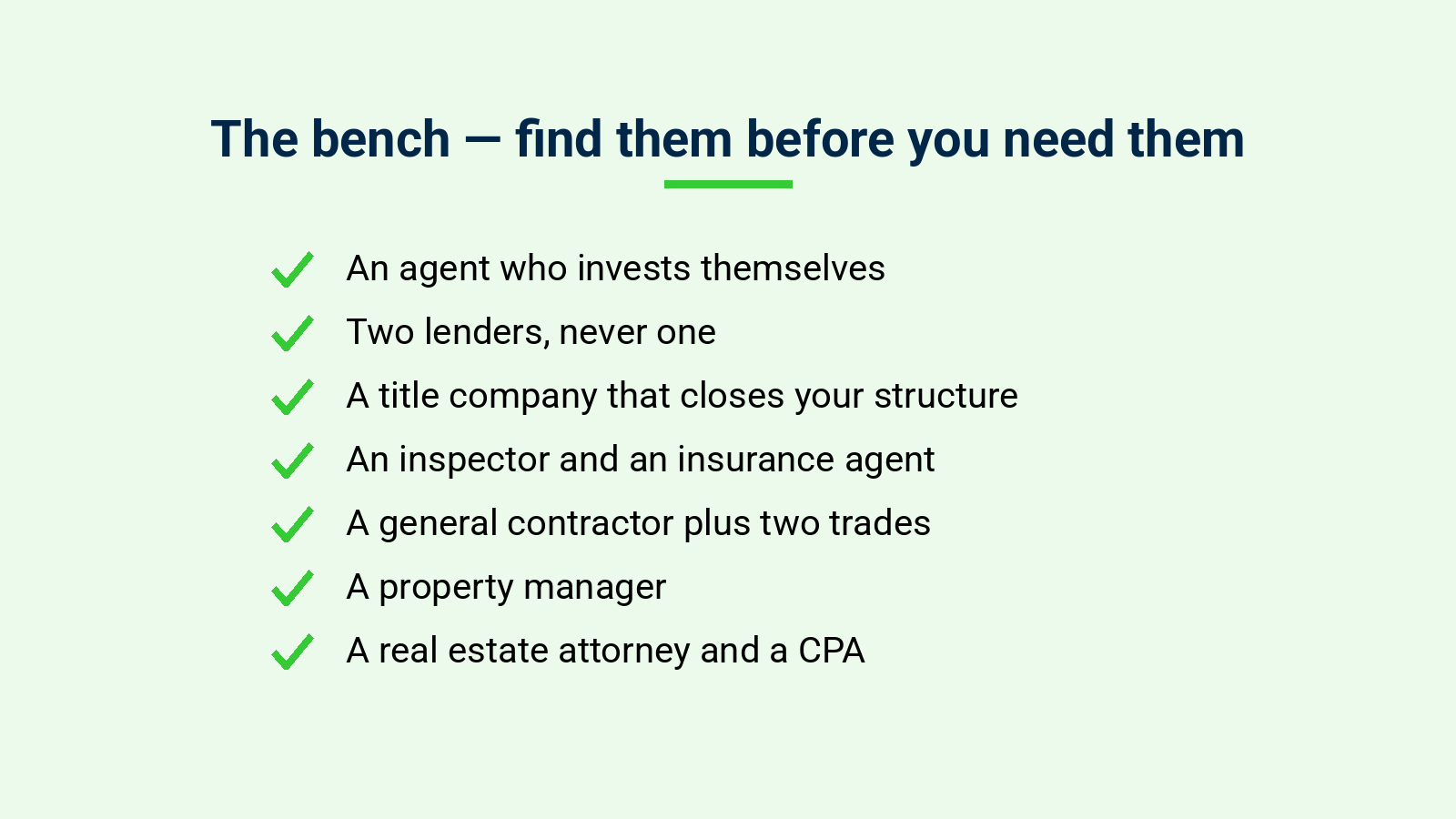
Nine roles, and closer to twelve actual people. You will not find them by posting in a Facebook group.
You find them by going to the same rooms repeatedly. Rooms reward frequency far more than intensity. Turning up once and collecting contacts gets you a phone full of people who don't remember you; turning up monthly for four months makes you a person, and people refer people rather than strangers. (The mechanics of doing that well are the subject of the other article linked at the top — worth reading before your first one.)
Two things speed this up.
Be useful before you need anything. Answer the question you happen to know the answer to. Make the introduction that costs you nothing. In a room where most people want something, giving first is unusual enough to be remembered.
Use the referral chain. End every conversation with some version of "who else should I know?" Then watch for the names that come up three separate times from three unconnected people. That repetition is the closest thing to a reliable signal you'll get in a market you can't read yet. It beats reviews, it beats advertising, and it costs nothing but the asking.
Days 61–90: make small, reversible bets
Now you can start. Carefully.
Your first deal in a new market should be one you can afford to be wrong about. Not the biggest one you can qualify for — the one where being wrong costs you money and a lesson rather than the whole plan.
The most useful filter we know is reversible versus irreversible. A cosmetic rehab you could list or rent either way is reversible. A heavy structural project in a neighborhood you've known for eight weeks, financed short, with one exit, is not. Early on, pay a premium for keeping your options open.
And don't change two variables at once. If a heavy rehab is new to you and the market is new to you, you'll have no way of knowing which one hurt you when it goes wrong. Do the thing you already know how to do, in the place you're still learning.
It is completely fine if day ninety arrives with no deal. Ninety days spent learning a market and building a bench isn't lost time — the people who lose money in a new market almost never lose it by moving too slowly.
The four mistakes we'd warn you about
- Buying in month one. The excitement of a new market can feel a lot like conviction. Usually it's unfamiliarity you haven't noticed yet.
- Trusting a national number over a local one. A statewide or metro average tells you nothing about your four streets, and your four streets are the only thing you're actually buying.
- Hiring the first contractor who answers the phone. In a market where you know nobody, availability is not a recommendation. Sometimes it's a warning.
- Treating the network as a task to finish. People can feel the difference between somebody building relationships and somebody harvesting contacts, and the second one quietly closes doors.
Start with a room instead of a spreadsheet
If we had to hand somebody one instruction for their first ninety days, it would be this: get in a room with people who already own things where you're going, and then go back next month.
Almost everything in this article routes through that — the part of your comp set you can't look up, the twelve people on the bench, the name that comes up three times.

If you're starting somewhere new
Come to the meetup and say so out loud. "I'm new here, I'm looking at the north side, and I don't know anybody yet" is one of the easiest openings in the room, because most people there remember being exactly that. In our experience, people who do that leave with real connections and something like an action plan — enough to cut through the noise and walk out with more clarity than they walked in with. Where and when: vinandmichelle.com/meetup